Get access to workforce-ready skills beyond a normal degree
CLEAN CREATE unites researchers, educators, industry, and government organizations to work on interesting problems to support engineered barriers for defence-in-depth applications

man-made or technological structure designed to isolate hazardous materials, or to prevent unwanted exposure between a risk source and the environment

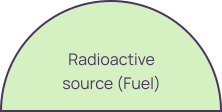
1. Site selection:
- Indigenous inclusion (DGRs)
- Geotechnical processes (DGRs)
2. Out-of-core containment
- On-grid security (SMRs)
3. Fuel cladding:
- Chemical reactivity of cladding (Operation, DGRs)
- Advanced manufacturing of cladding (Operation, DGRs)
How the program works
CLEAN provides a flexible, multifaceted, and sustainable mobility approach via:
- a central learning experience through an annual Symposium
- the completion of one out of three additional learning streams:

Lab Exchange
- 4-8 week lab immersion experience
- Designed for mobility of students between research laboratories (from the CLEAN Team, or external to CLEAN) with overlapping research areas
- The technical skills gained can include:
- Developing experimental design, test matrices and operating procedures
- Using advanced material characterization instruments to study key materials.
- Using state-of-the-art beam facilities (neutron or proton) or research reactors (SLOWPOKE)
- Modelling and analysis of cyber vulnerabilities and failure propagation in smart grid networks
- Testing of materials in high-temperature and high-pressure equipment (autoclaves, flow-through loops)
- Working in specialty environments (glove boxes, hot cells, clean rooms)
- Manufacturing of materials using advanced methods (LPBF, WAAM, etc.)

Industry Internships
- 4-8-month duration (flexible)
- Locations across Canada with industry partners such as Kinectrics, CNL, Calian Nuclear, and many others
- Industry focused training and a career portfolio that will accelerate the transition to the nuclear workforce
- Pipeline for industry-focused internships and HQP mobility from regions of Canada that are still developing a nuclear industry footprint
- Technical skills through the use of laboratory facilities and equipment, data collection, visualization and analysis, and engineering design

experience!
Workshops and Micro-Courses
Topics include:
- Cyber Resilience Training
- Environmental Impact Assessments
- Computational Skills
- Leadership
- Quality Assurance fundamentals


Eligibility Criteria
Must be enrolled in an undergraduate/graduate degree program (Natural Sciences and Engineering (NSE) and non-NSE students are eligible) within one of the following Canadian universities:
- University of Calgary
- University of Regina
- University of New Brunswick
- Royal Military College of Canada
- McMaster University
Requirements
- Be able to fulfill their regular degree requirements.
- Attend the annual CLEAN Symposium which will rotate through Alberta, Saskatchewan, Ontario, and New Brunswick.
- Attend one of the the following conferences: CNA Ottawa, CNA West, or CNA Atlantic.
- Be able to fulfill their regular degree requirements.
- Attend the annual CLEAN Symposium which will rotate through Alberta, Saskatchewan, Ontario, and New Brunswick.
- Attend one of the the following conferences: CNA Ottawa, CNA West, or CNA Atlantic.
How to apply
Be enrolled in an undergraduate or graduate degree program at Canadian institution.
CLEAN CREATE institutions:
- University of Calgary
- University of Regina
- University of New Brunswick
- Royal Military College of Canada
- McMaster University

If you are enrolled in one of the CLEAN institutions
reach out to the respective CLEAN team faculty members about becoming a CLEAN CREATE student or participating in CLEAN CREATE events.

If you are an undergrad at an institution not listed above
inquire about pursuing an undergraduate research project, MSc, or PhD with a CLEAN team faculty member whose research areas interest you.

If you are a student at an institution not listed above
please reach out to cleancreate@unb.ca to find out ways to participate in our events.


There is a place for everyone in the nuclear field!
“I thought I had a good understanding of the career opportunities within the nuclear field… I was surprised to learn that the nuclear industry is much more diverse… safety, education, cyber security, research, operations and more. The PLNGS tour gave me an appreciation for the planning and collaboration that goes into operating a nuclear plant.”

CLEAN is the perfect opportunity to get actual exposure to the nuclear industry.
“It was such a pleasant surprise when the panel from the Point Lepreau sat down and demonstrated how we have top-shelf Canadian nuclear expertise even beyond Ontario. The Additive Manufacturing sessions were also intriguing; especially the promise of being able to continually keep a reactor supplied via exact replacement components.”
